Thursday, November 18, 2010

Survey Says!

On Day 15 of NaNo, I created a Survey Monkey survey so that I could check in with my students. This was so incredibly easy to create and implement, I know I will keep using this tool.

This is what the survey looked like.


I have 15 students, and 13 of them took the survey, and I have decided to share this enormous amount of scientific data with you.

And because I am also trying to get to 50,000 words while teaching classes, grading papers, living life, and blogging about this teaching experience, I am going to post the results one or two questions at a time, along with a little reflection on those results. 


Tomorrow's post: the "gamification" of writing a novel. 


Friday, November 12, 2010

Writing Together

On Monday, I opened the door to my classroom and my Advanced Fiction students filed inside. I opened up some cookies, scattered some leftover Halloween candy on the desk. I showed them that we’d received another postcard from the students in Lori Rader Day’s class. They’re doing NaNo, too. I passed around a postcard, and a few students wrote down their words of encouragement.


I walked around the room to find out how everyone was doing. “What’s your word count?” Some people started in October and are farther along than others. At this point, one week in, they should be at about 25% of the goal or 12,500 words. Most were. Some weren’t, but they recognized this and told me their plan to get back on track. I marked their progress on this handy-dandy poster I got from the Office of Letters and Light.  


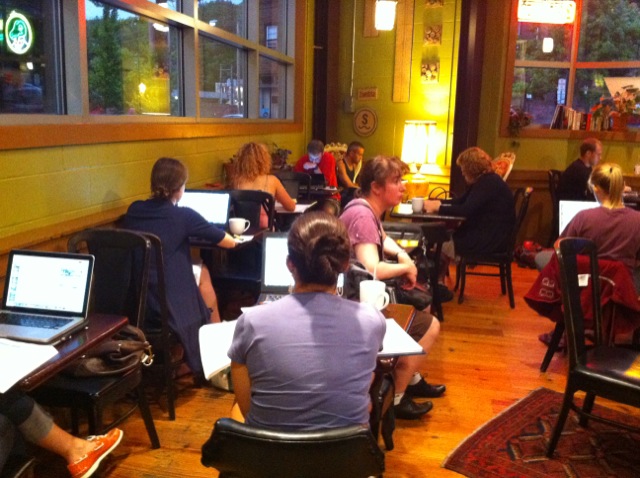
They settled in. Some like to use the computers already in the room, always the same one, same spot. Some bring their own laptops. Some sit on the floor. One student brings her own pillow for this purpose. They fired up their iPods. Logged into 750words.com. Opened up Word or Q10. And then they started writing. Tap tap tapping. Everyone entered the world of their story.

I have been teaching creative writing for almost 20 years, but I’ve never witnessed anything like this.

My students.

Writing.

Right in front of me.

Usually, this activity takes place privately, out of sight, and I am merely presented with the fruits of said activity. Over the course of the semester, I’ve slowly gotten them used to writing in this room, with each other. It wasn’t easy. Many of them resisted, and I understand why. I’ve never liked writing in public places—coffee shops, libraries, etc. But I’m realizing now that there’s something profoundly comforting about doing so, like the difference between practicing yoga alone vs. in a studio full of people.


Writing is a profoundly meditative activity, and to do so in the presence of others reminds us that we aren’t alone in this endeavor. Anti-NaNo-ists are troubled by the idea of millions of people engaged in the act of writing—alone or in small groups, in real rooms and virtual ones—but I don’t understand why they are so troubled.

This morning, I got up at 6 AM so that I could spend an hour inside the world of my book. This is my 43rd day of continuous writing. Sometimes, I rise a little earlier than normal so I can get my words in before the day begins. Sometimes, I close the door to my office for twenty minutes. Sometimes, I write in the classroom with my students. I’ve come to look forward to this time. Its sanctuary. Its blessing. I’m beginning to realize that writing isn’t something I should associate with a physical place. Not a desk. Not a particular computer. Not a room. Rather, it’s like a small garden in my head, and finding a way to spend time in that garden—making time for it—is what matters.

Everyone wrote for 70 minutes or so, and then I gently announced that class was almost over. Slowly, we all left our stories and returned to the room, returned to the real world. We looked around at each other. And then we left the room and went on with our days.

Wednesday, November 10, 2010

Publicity as a Motivator

The Ball State Daily News ran a story today about National Novel Writing Month.

Seriously. Front page. Above the fold.

The neighboring headline read "Sex Study places BSU 31st." And right above, there was a huge picture of Conan O'Brien. So: the editors could have led with a story about S-E-X, or a story about a HUGE CELEBRITY, but instead they went with a story about a bunch of students writing fiction.

Which is pretty awesome, I think.

It was a nice article (thanks Keshia Smith!) and it definitely got my students pumped today. They walked into class full of energy and quickly got to work. Making the front page of the student newspaper will do that to you.

This is what my classroom sounded like today. I think it's a glorious sound.

Tuesday, November 9, 2010

Facebook: The Pedagogy Forum

Over the weekend, I responded to a Facebook status update. 

"KYLE MINOR notices that MFA programs are producing more good short story writers than good novelists. Many of my friends from many different programs have had difficulty, post-graduation moving from the short form to the long. Five-plus years into this novel, I've come to believe that the novel and the story are very different animals which might require different training."

And so began an interesting exchange, lots of writers discussing their experiences as students and teachers. One of the responders, Michael Nye of The Missouri Review, just posted his thoughts on TMR blog. You need to read this. 

Any veteran of fiction workshops can tell you: the short story is a more workable and practical pedagogical tool than the novel. Nye discusses this at length. I related to many of his frustrations, both as a former student and as a teacher and mentor.

However, I remain convinced that writing programs can (and should) accommodate both long and short-form fiction. I don’t agree that a writing program is only capable of teaching you how to write a short story, that graduates of fiction workshops must figure out how to write novels entirely on their own.

We can do it. We just have to start thinking outside the box we've been living in for 50 years.

Do you teach fiction writing in a creative writing program? Then read Kyle Minor's FB thread. Read the responses to Nye's blog post. Think about your own pedagogy. Talk about it here or elsewhere. If you've figured out ways to encourage novel writing in your classes, share your insights and ideas.

Because it seems clear to me that inquiring minds want to know. 


Sunday, November 7, 2010

Five (or Six)

Charles Demuth, Figure 5 in Gold

A few days ago, Sonya Chung posted this great essay on The Millions about being a teacher of creative writing and about the uncertainty that’s inherent to the writing life.

She mentions a recent visit from author Jennifer Egan, who confessed to being an “unconscious writer. The first drafts of her novels are written by hand on legal pads. The handwriting is illegible. She doesn’t consciously think about craft at this stage. She just goes, and because she’s writing by hand instead of on the computer, she doesn’t fiddle with what she’s written. It’s only after she’s hand-written a full draft that she goes back and revises and shapes and crafts and starts thinking and making choices.

Chung says one of her students raised her hand asked Egan about what sort of goals she sets, given her largely unconscious way of writing.

“Five pages,” she said. “Every day I aim for five pages. It doesn’t matter how much time I spend, I could sit for three hours and not get any pages. I’m after the pages.” I saw a number of students scribbling in their notebooks. I thought I heard a collective exhale of relief. Five pages. Something concrete, something quantifiable." 

It’s worth pointing out that a NaNo participant is doing the same thing as Jennifer Egan. Some proceed with a plan, some without, but still, they’re just trying to get pages done every day. Not five, but six pages down every single day during the month of November.

The next time I hear someone criticize NaNo, I’m going to tell them that Jennifer Egan is a NaNo writer, too. And I'm going to tell them to read this passionate, articulate defense, too. 

Egan's not an official NaNo Novelist, of course. She doesn’t sign up on the website or get a widget. She doesn’t need external reinforcement and the behavioral rewards system. Maybe she did once upon a time, who knows? She's come up with her own regimen, which she self-enforces.

[Which begs the question "Does writing performed with the aid of constraints or rewards make said writing less valid than writing performed without those aids?" I'll address that issue soon.] 

My students are very resistant to the idea of writing a shitty first draft, to letting their unconscious minds run amok. They say to me, “I respect novels too much to write something crappy.” Or “I had three hours to write new pages today, and all I did was fiddle with what I wrote yesterday. I can’t stop myself.”  Or “It’s just embarrassing to me to know that I have written all these crappy sentences. Eventually, I will have to fix those crappy sentences, so why not now?”

All their lives, they’ve had to write, tinker, turn in, get a grade. The rhythm of the semester demands that a messy first draft needs to quickly become a polished final draft. It’s interesting to me that even though I’ve said to them over and over again, “You're not required to turn that messy first draft into a polished final draft. So just write. I'm not grading this." But the impulse to “revise as you write” is so well ingrained they want to do it anyway. Some days, I have to forcibly tell them to stop it.
"Five."

[Could it be that it's the "credentialed writers" especially, those who emerge from writing programs, who have the most difficulty moving from short stories to novels? I'll address that issue soon, too.] 

For now, I'm going to tell my students about Jennifer Egan’s process. Five—or six—pages every day. 

Wednesday, November 3, 2010

"Workshop" to "Writing Group"


I love what Peter Turchi has to say about workshop here. This and Madison Smartt Bell’s introduction to Narrative Design have really informed my thinking about how I teach workshops.

When I’m teaching a workshop in which students are sharing “big things,” I ask them to read Turchi’s essay, especially this part:

The first step in preparing to discuss another writer’s draft is to try to identify the work's intention. This is much more challenging than it might sound. It’s difficult to truly suspend our own tastes; it’s also difficult to identify with any confidence the intention of a work that isn’t fully realized (especially since the author might not have a clear intention, yet). But we need to try; and we need to be patient in doing that before we start talking about any specific scene or character or line of dialogue or description. (Far too often, workshop discussions are devoted to a few details at the expense of the whole.)

How do we recognize the intention of a work in progress? When students are workshopping stand-alone short stories, my mantra is: The story must speak for itself. But when students are workshopping big things, I think it’s okay (and necessary) for the author to speak on behalf of the manuscript. Not during the workshop itself, which causes much awkwardness, but before class, outside class. 

Idea: require students to use the Blackboard learning environment to create a process blog about their big thing. Ask each writer to articulate the larger goals of the project, its structure, the character’s overall arc, the possible chapters to come, where things are going.

Another idea: require students to turn in their pages presented like a book manuscript: cover page with title and contact information, table of contents, epigraph, even maps and photographs, if they wish. I teach them to use the abbreviation “TK,” the printing reference that signifies that additional material will be added at a later date. If they think their book will be comprised of eight stories, but they’ve only written two and a half and the other five are still in their heads, I tell them, yes, it’s okay to give us two and a half stories, to give us placeholder titles, maybe even short synopses of what is “to come.” Basically, they need to teach us how to read their book. We need to know: are we reading stand alone stories, related stories, or a novel?

This approach often shifts the default setting of the class from “workshop” to “writing group.


Monday, November 1, 2010

NaNoDra2Mo?

Not only do I want to change the name from “Novel Writing” to “Novel Drafting,” I also want to change it from one month to two.
National Novel Drafting Two Months!
NaNoWriMo creator Chris Baty says he picked November as National Novel Writing Month because “it’s a bad weather month.” Really? What about the long, dark nights of February or March? Why not schedule NaNoWriMo in say, May or June, when lots of people start Summer Projects? Or what about September! It’s time for school and shiny pencils and new notebooks. You’ve got back-to-school energy, even if you’re not in school. November? My internal batteries are fading. Why November? It’s a busy month. Final projects. Deadlines. End-of-year reports. Plus the holidays. Commitments to family and friends. How does anyone expect you to do anything this big during November?
But that’s the beauty of it, see. Because who doesn’t have a ton of shit to do all the time? As I tell my students: You’ll probably never have time to “just write,” so ask yourself how you’re going to organize your life so you can get writing done. How are you going to incorporate it into your already scheduled life? What’s on your plate? What can you remove from that plate? And what can be shifted around to make room for writing? Now, nobody’s asking you to quit your job or break up with your girlfriend or flunk a class or stop tucking your kids in at night. What about television? Gaming? Facebooking? Yammering? Putzing? Hard-core partying? Recovering from hard-core partying? Shopping on Etsy or Ebay? I don’t know…whatever else it is that you do that I can’t think of because I’m old and boring.
Still, I was worried. Maybe it’s not possible or reasonable to ask the average college student to draft a novel during November. Maybe it contributes to their well-ingrained “binge” mentality. They deny themselves all week, and then binge drink on the weekends. They don’t write anything for months, and then binge write for 30 days. Is this healthy? Then my husband said, “I don’t know how they can stand the suspense. Why don’t you just let them start?” 

So I decided to offer the class a choice: They could participate in NaNo just as Chris Baty intended, or they could modify the experiment and start writing on October 1. Instead of writing 1667 words a day for 30 days of November (NaNoWriMo), they could write 980 words a day for the 51 days of October and November (NaNoDra2Mo). 
[Wow, do I suck at math. Wow. Make that 819 words a day for 61 days. Because 31 + 30 = 61. Yes.]
At the end of September, I gave my students an in-class timed writing exercise: write a profile of your main character. They wrote for about 30 minutes. Then I had them shout out their word count. Some typed swiftly—no editing or tweaking—and pounded out over 1000 words. Others wrote more slowly and laboriously, only producing about 300 words.
I said, “Okay, some of you wrote quickly and some of you didn’t. There’s no right way to write. But what does this exercise tell you about how much time you need to write 819 words? To write 1667 words? For those of you who wrote quickly, you could do what you just did—spend just a half hour at the keyboard every day for two months—and you’re done. You could go on with the rest of your day. You'll hardly notice the difference--other than the great feeling that comes with writing a little bit every single day. For those of you who wrote slowly, how much more time do you need to write 819 words? To write 1667? And ask yourself if you can realistically create that much time in your day? Maybe you need to use both October and November to accomplish this task. Or maybe you need to stop being so hard on yourself and just write like hell. Don’t edit or spell check. Get out of your own way and just go.”
So: half the class started on October 1st, and they are all about half way to the goal of 50,000. The other half of the class decided to wait and start on November 1st.
I’ll keep you updated on their progress.